
Section 4 of 7
Incoterms® 2020 & Contracts
What Incoterms are and why they matter
Every international sale involves a journey — from the seller’s premises to the buyer’s door, or somewhere in between. Along that journey, someone has to arrange transport, someone has to insure the goods, someone has to clear them through customs, and someone bears the risk if something goes wrong. Incoterms® 2020 are the internationally recognised rules that define exactly where those responsibilities sit.
Published by the International Chamber of Commerce (ICC) and recognised by customs authorities, courts, and trading partners worldwide, Incoterms are not a legal requirement — but in practice they are the common language of international trade contracts. Agreeing and stating an Incoterm clearly in your contract, commercial invoice, and order acknowledgement is one of the simplest ways to avoid disputes about who was responsible for what when something goes wrong.
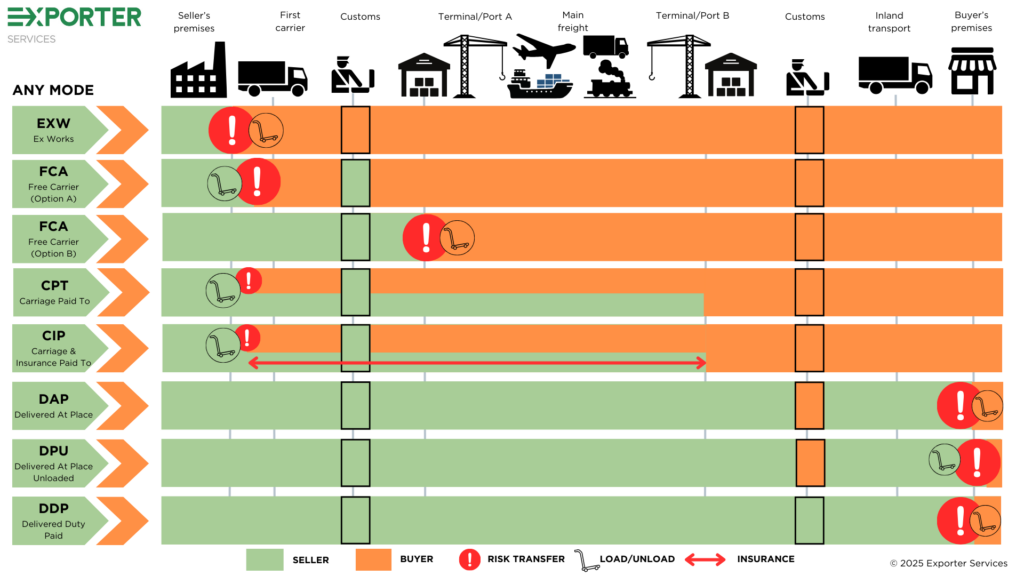
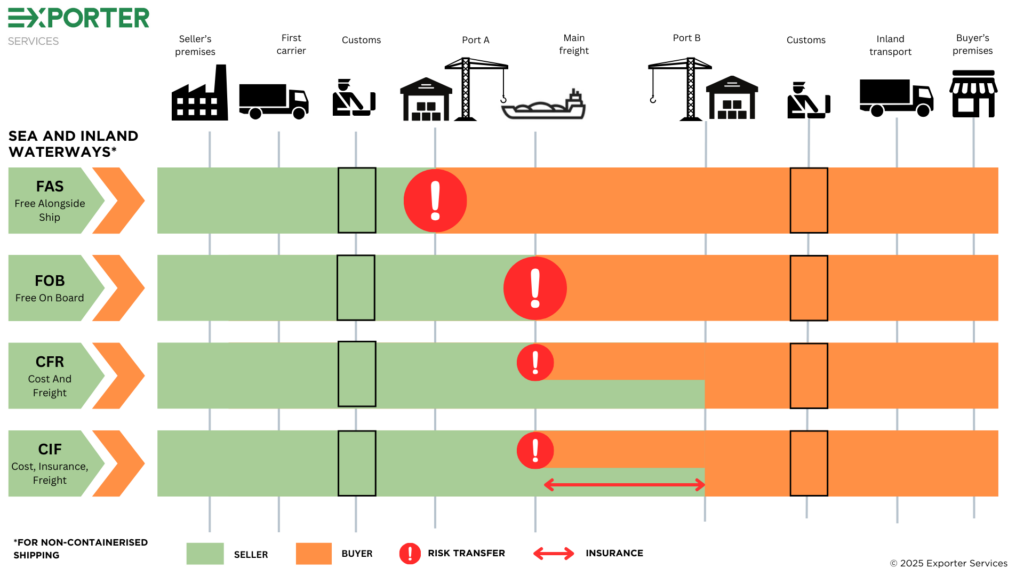
There are eleven Incoterms in the 2020 edition. They divide into two groups: seven that apply to any mode of transport — air, road, rail, or containerised sea freight — and four that apply only to sea and inland waterway shipments where goods are not containerised. Using a sea-only term for a containerised shipment is one of the more common Incoterms errors in practice, and one with real consequences for who holds risk during transit.
What each Incoterm determines is the same across all eleven: who arranges and pays for carriage, where and when risk transfers from seller to buyer, who is responsible for export and import clearance, and — in two specific cases — who must arrange insurance.
Some common terms you will likely encounter
EXW — Ex Works
Ex Works represents the minimum obligation for the seller. The goods are made available at the seller’s premises, and from that point the buyer takes on responsibility for everything — collecting the goods, arranging export clearance, organising transport, and handling import at the other end.
On the face of it, EXW looks attractive to exporters: minimal responsibility, minimal involvement. In practice it creates problems that are worth understanding before agreeing to it. Because the buyer is responsible for export clearance, they need to be a registered entity in the UK with an EORI number — or they will use yours, which means the declaration is submitted in your name, with your legal exposure, based on information you may not have controlled. Proof of export also becomes significantly harder to obtain, because you are not arranging the transport and have no automatic right to the documentation you need.
FCA — Free Carrier
FCA is widely considered the most practical term for UK exporters, and is the one most commonly recommended as an alternative to EXW. The seller is responsible for export clearance and for delivering the goods to a named carrier or location — after which risk transfers to the buyer.
Like EXW, FCA is a collection term — the buyer arranges for a carrier to collect from the seller’s premises. But unlike EXW, the seller completes the export declaration and loads the goods, which resolves the two most common practical problems that EXW creates.
For a detailed look at why FCA is a stronger choice than EXW for most UK exporters, see our post: Why FCA is a better choice than EXW for UK exporters.
DAP — Delivered at Place
DAP is one of the most popular terms in UK export trade. The seller arranges and pays for transport to an agreed destination — typically the buyer’s premises or a named location in their country — and risk transfers when the goods arrive and are ready to be unloaded. The buyer is responsible for unloading and for import clearance and duties at their end.
DAP works well when the seller wants control over the movement of goods and the buyer wants delivery to their door without having to arrange transport. The responsibilities are clearly defined and the term is well understood by freight forwarders on both sides.
One practical issue worth flagging, particularly with EU buyers: import clearance under DAP is the buyer’s responsibility, and not all buyers fully appreciate this until the goods are sitting at the border waiting to be cleared. This can lead to delays, storage charges, and a difficult conversation about who is liable for the consequences. If your buyer is not familiar with the import process in their own country, it is worth establishing this before agreeing DAP.
DDP — Delivered Duty Paid
DDP represents the maximum obligation for the seller. Under DDP, the seller arranges everything — export clearance, international transport, import clearance, and payment of duties and taxes in the destination country — delivering the goods to the agreed place, ready for the buyer to unload.
It is a term that can work very well commercially, particularly where buyers want a simple, all-inclusive price and do not want to deal with import formalities. But it requires careful planning and the right support in place, because what DDP involves in practice varies significantly depending on the destination country. Being the importer of record in another country — which DDP requires — is not always straightforward.
What Incoterms do not cover
Incoterms define the physical and logistical responsibilities for moving goods. They do not determine when payment is made — that is governed by your payment terms, agreed separately. They do not specify what documentation is required beyond the basics — that depends on the goods, the destination, and your contract. And they do not override the laws of the countries involved in the transaction.
They also say nothing about title — ownership of the goods — which is a separate contractual matter entirely.
Insurance and Incoterms
Only two of the eleven Incoterms place an obligation on either party to arrange insurance: CIP (Carriage and Insurance Paid To) and CIF (Cost, Insurance and Freight). Under all other terms, insurance is not mandated — but that does not mean it is not needed. Where either party bears the risk of loss or damage during transit, they would be prudent to consider whether their goods are adequately covered.
The level of cover required under CIP and CIF differs, and the distinction matters. It is one of the details that often gets missed.
Choosing and using Incoterms correctly
The right Incoterm for any given shipment depends on several factors: the destination, the nature of the goods, the logistics arrangements, your relationship with the buyer, and the commercial terms you have agreed. There is no universal answer — but there are better and worse choices for given situations, and some choices that create problems that were entirely avoidable.
The Incoterm should be agreed before the contract is signed, not added to the invoice as an afterthought. It should be stated in full — the three-letter abbreviation plus the named place, plus a reference to Incoterms® 2020 — to avoid ambiguity. And both parties should understand what they have agreed to, which is less common than it sounds.
Incoterms should also be reviewed periodically. Trading relationships change, logistics arrangements change, and the term that made sense three years ago may not be the right one today.
Understand Incoterms in practice
Our Understanding Incoterms 2020 course covers all eleven terms with practical examples, worked scenarios, and the space to ask questions specific to your goods and markets. Available as a public live online session, on-demand recording, or private training for your team.
View the Incoterms CourseNot sure which Incoterm is right for your contracts?
Getting Incoterms wrong can be costly — for your costs, your risk exposure, and your customer relationships. Our consultancy team can review your current arrangements and advise on the right terms for your specific markets and trading relationships.
Speak to Our TeamThe Complete Guide to Exporting from the UK
- 01 — Understanding the Export Process
- 02 — Export Documentation
- 03 — Customs, Declarations & Commodity Codes
- 04 — Incoterms® 2020 & Contracts You are here
- 05 — Trade Agreements, Rules of Origin & Reducing Duties
- 06 — Getting Paid & Managing Financial Risk
- 07 — Export Controls & Licensing