Section 3 of 7
Customs, Declarations & Commodity Codes
Why customs compliance matters
Every export from the UK requires a customs declaration. It is not optional, it is not something only large businesses need to worry about, and it is not simply an administrative formality. It is a legal requirement — and the information submitted in it has consequences that run through every other aspect of the export, from VAT zero-rating to whether your buyer can claim reduced duty at their end.
Customs compliance is also one of the areas where the gap between what businesses think is happening and what is actually happening tends to be widest. Many exporters rely entirely on their freight forwarder or courier to handle declarations, which is entirely legitimate — but it does not transfer the legal responsibility. The exporter of record remains accountable for the accuracy of the information submitted, regardless of who submits it.
Commodity codes — the number that determines almost everything
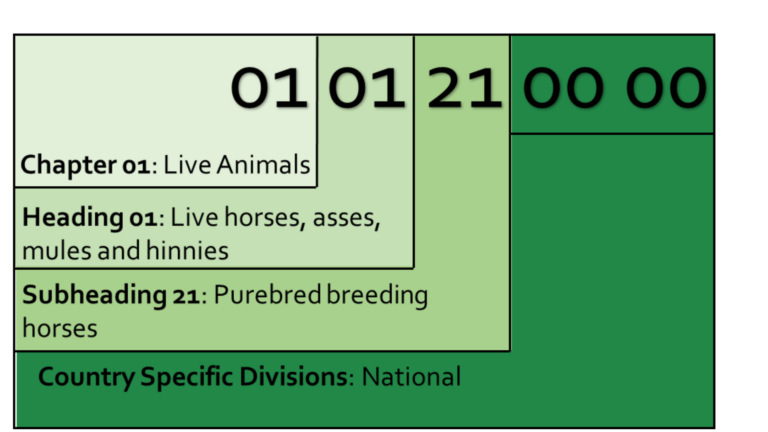
A commodity code is a numerical classification assigned to goods for customs purposes. In the UK, classification is based on the international Harmonized System (HS), which provides a common framework used by customs authorities around the world. The first six digits of any commodity code are standardised globally. Additional digits are added at national level for import purposes, making the full code longer depending on the country.
For UK exports, you need an eight-digit code.
The commodity code is not just a reference number. It is the classification from which almost everything else in the export flows.
Export controls and licensing. The Trade Tariff will tell you whether your goods are subject to export controls or have a dual-use classification — meaning they could have both civilian and military applications. An incorrect commodity code means you may not know a licence is required until something goes wrong.
Rules of origin. Whether your goods qualify for preferential treatment under a trade agreement is assessed at commodity code level. The rules vary by code and by destination country, and getting the classification wrong means the rules of origin assessment may also be wrong.
Duties at the destination. Your buyer’s ability to import your goods and at what duty rate depends in part on how they are classified at their end. While the UK export code and the import code in the destination country are not identical, they share the same HS foundation — a significant misclassification on your side may create problems on theirs.
The declaration itself. The commodity code appears on the export declaration. If it is wrong, the declaration is wrong — and that has compliance and audit implications.
Finding the right commodity code
The UK Trade Tariff is the tool for finding and checking commodity codes. It is searchable, browsable by category, and contains significantly more information than most exporters realise. Beyond classification, the Trade Tariff shows export controls, rules of origin by destination country, and notes that help confirm whether a classification is correct.
Finding the right code requires more than a keyword search. Goods that appear similar can sit in very different headings depending on their composition, function, or intended use. The notes sections within the Tariff — which many users skip — often contain the detail that determines whether a classification is right or not.
It is also worth being aware of the government’s Check Duties and Customs Procedures tool, which uses the commodity code to provide destination-specific information — duties payable, documentation requirements, and country-specific rules. It is one of the most useful and least-used resources available to UK exporters.
The responsibility for correct classification sits with the exporter. Errors — whether deliberate or accidental — can result in delays, penalties, and compliance exposure at both ends of the shipment. If you are not confident in your current codes, that uncertainty is worth resolving.
The customs declaration — what it is and who is responsible
The export declaration is the formal submission made to HMRC via the Customs Declaration Service (CDS) that notifies the authorities of an export movement. It is a legal document. The information it contains — the commodity code, the value, the origin, the Incoterm, the exporter’s EORI number, and a procedure code that defines why the goods are moving — is what customs authorities use to assess and clear the shipment.
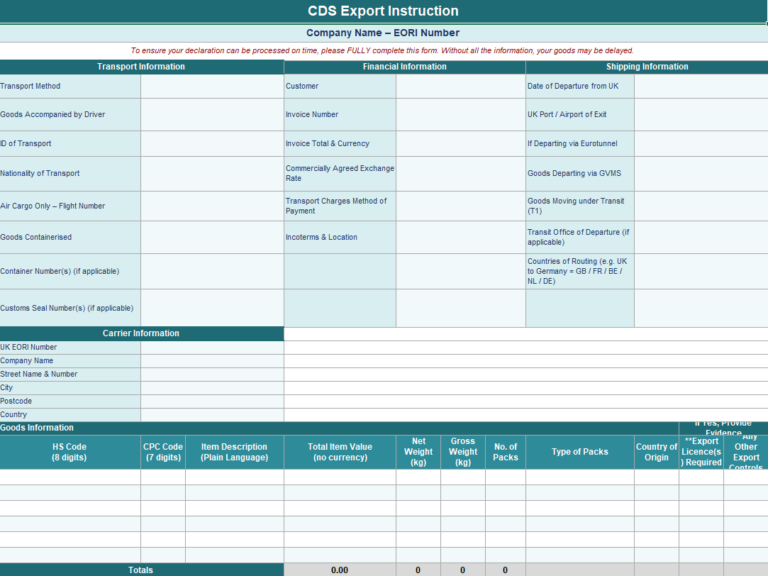
Most exporters do not complete their own declarations. Freight forwarders, couriers, and customs agents typically do this on behalf of their clients, usually acting as a direct representative — meaning they submit the declaration in the exporter’s name, using the exporter’s EORI number, based on the information the exporter provides. Using a third party to submit declarations is standard practice and makes sense for most businesses, but it does not transfer legal responsibility.
If the information on the declaration is wrong — because the commodity code was incorrect, the value was understated, or the goods description was too vague — the consequences sit with the exporter of record, not the forwarder. This is why the instructions you give your forwarder matter, and why checking what comes back matters too.
The declaration process has three stages: a safety and security declaration, the customs declaration itself, and an export border process that determines whether the goods are routed for a document check, a physical inspection, or cleared without intervention. Most shipments clear without issue, but the routing is determined by the information submitted — another reason accuracy matters.
Checking your customs declaration
Once a declaration has been submitted and cleared, the Full Entry Printout from CDS is the official record of what was declared in your name.
The Full Entry Printout is one of the two main forms of proof of export HMRC will accept — but it is also a compliance document that tells you exactly what was submitted on your behalf. Commodity codes, values, procedure codes — these are all visible on the printout, and errors in any of them are your responsibility, not your forwarder’s.
Reading a CDS Full Entry Printout is not straightforward. The document uses coded fields and procedure codes that are not self-explanatory, and knowing what to look for — and what a red flag looks like — requires familiarity with how declarations are structured. But the principle is simple: if declarations are being submitted in your name, you have both a right and a reason to understand what they contain.
If you have concerns about your current declarations, our team is happy to help — get in touch at team@exporter-services.co.uk.
Common mistakes in customs compliance
Delegating without checking. Using a freight forwarder to complete declarations is sensible. Assuming they are always correct — and never requesting or reviewing the output — is a compliance risk that many businesses carry without realising it.
Outdated or approximate commodity codes. Codes that were assigned years ago and never reviewed, or codes that were chosen because they were close enough rather than definitively correct, are more common than they should be. The Tariff is updated regularly, goods change, and a code that was correct five years ago may not be the right one now.
Incomplete or vague instructions to the forwarder. The declaration is only as accurate as the information provided. If the commodity code, goods description, or value passed to the forwarder is incomplete or incorrect, the declaration will reflect that.
Not obtaining the Full Entry Printout. As covered in Section 2, this is proof of export — but it is also the only way to verify what has been declared in your name. Not having it is both a VAT risk and a compliance blind spot.